

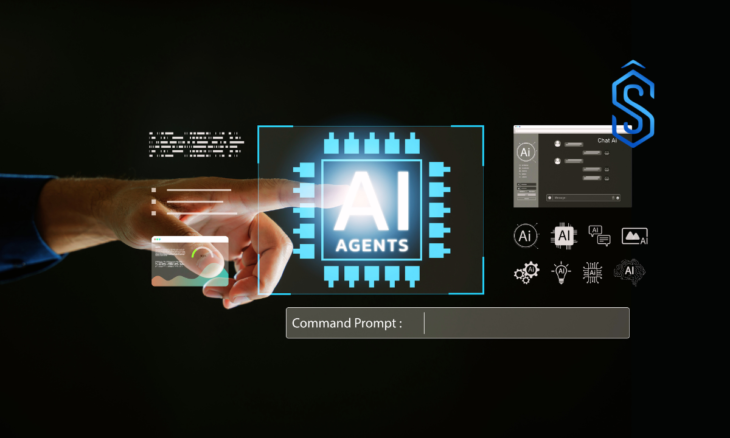
For years, enterprise networks were designed around a relatively simple premise: connect people, applications and systems reliably and efficiently. That premise is now being challenged by the rise of agentic AI.
Unlike conventional AI tools that respond to a prompt, AI agents can interpret context, plan actions, interact with applications and APIs, and execute tasks with limited human intervention. This changes not only how enterprises work, but also how their digital infrastructure needs to be designed.
India is already moving from AI experimentation towards enterprise deployment. According to the EY-CII AIdea of India: Outlook 2026, 47% of Indian enterprises have multiple GenAI use cases live in production, while 10% are already scaling use cases across the business.
The same study found that 91% of business leaders consider speed of deployment the most important factor in their buy-versus-build decisions.
This acceleration raises a critical infrastructure question: Are enterprise networks designed for the way AI will operate?
Enterprise Networks: Agentic AI Changes the Role of the Network
An AI agent does not operate in isolation. To complete a task, it may need to access enterprise applications, retrieve information from databases, interact with APIs, connect to cloud platforms and exchange data with other systems.
As enterprises deploy multiple agents across functions such as customer service, finance, operations, cybersecurity and supply chain management, these interactions will become increasingly continuous and distributed.
This means the enterprise networks can no longer be viewed simply as a transport layer. It becomes part of the operating environment for AI. The requirement is no longer connectivity alone.
Enterprise networks should provide high bandwidth, low latency, resilience, security and predictable performance across increasingly distributed workloads.
For Indian enterprises, this shift is particularly relevant as AI infrastructure itself expands rapidly.
The IndiaAI Mission had onboarded more than 38,000 GPUs to its common compute facility by March 2026, with the government also announcing plans to add another 20,000 GPUs.
The growth of compute capacity will create corresponding requirements for connectivity, data movement, storage, cloud access and secure infrastructure.
Also Read: Tata Elxsi Makes Strategic Investment in KAVIA AI for Enterprise AI Engineering
Enterprise Networks: Latency Becomes a Business Variable
For conventional enterprise applications, network latency has traditionally been treated as an IT performance metric. Agentic AI changes its significance.
When an AI agent is coordinating a sequence of actions, every interaction with an application, database, model or external service contributes to the overall response time.
Consider an AI system supporting a supply-chain operation. It may need to retrieve inventory data, assess demand, interact with an enterprise resource planning system, identify a logistics option and initiate an action.
If these systems are distributed across different environments, the network becomes part of the decision-making chain.
This makes high-speed and low-latency connectivity increasingly important for AI-enabled business processes. It also makes resilience critical.
As enterprises distribute workloads across multiple data centres, cloud environments and edge locations, a network failure can affect more than application availability. It can interrupt an autonomous workflow that is actively performing a business function.
The infrastructure supporting AI therefore needs redundancy, multiple connectivity paths, intelligent traffic management and continuous monitoring.
Enterprise Networks: Security Has to Move with the Agent
Greater autonomy also creates a different security challenge. An employee using an AI assistant typically initiates an interaction. An agent, by design, may initiate multiple actions across enterprise systems.
That means the security architecture needs to account not only for who is accessing a system, but also what an AI agent is permitted to access, which actions it can perform and how those actions are monitored.
This makes identity, access controls, segmentation, encryption, threat monitoring and governance integral to AI infrastructure.
The need for control becomes even more important when enterprises work with sensitive customer information, financial data, intellectual property or regulated datasets.
This is also where sovereign infrastructure becomes relevant. Sovereignty is not simply about keeping data within national borders.
It is about maintaining greater control over where data is stored and processed, who can access it, how workloads are governed and how infrastructure is managed.
For Indian enterprises, this can enable AI adoption while addressing requirements around data localisation, security and regulatory control.
Enterprise Networks: Infrastructure Will Determine How Far Agentic AI Can Scale
India’s AI journey is moving into a more consequential phase.
EY’s research shows that enterprises are already moving multiple GenAI applications into production, while PwC India’s research highlights the growing expectation that AI will fundamentally change how organisations create and capture value.
The next challenge is therefore creating the infrastructure that allows those models and agents to operate reliably inside the enterprise networks.
The organisations that gain the greatest value from agentic AI will not necessarily be those that adopt the most AI tools. They will be those that build the infrastructure to connect AI with their data, applications and business processes securely and at scale.
That requires a different approach to enterprise networking. The network of the future will not simply connect users to applications. It will connect AI agents to the systems through which businesses operate.
As agentic AI moves from experimentation to mission-critical deployment, enterprise connectivity, cloud, data centres and cybersecurity will increasingly become one integrated infrastructure decision.
Pinkesh Kotecha, a first-generation entrepreneur, is the founder and driving force behind Ishan Technologies, one of India’s leading IT and Telecom service providers.